
Copper hits record highs amid US tariffs and supply concerns
- Copper hits an all-time high at $14,697 per ton on Tuesday after rallying 2.75% so far in September.
- Anticipation of additional US tariffs and supply-side constraints are seen as the main reasons for Copper's rally.
- XCU/USD's technical picture shows an overextended rally ahead of the $15,000 psychological level
Copper prices have accelerated their rally this week, reaching an all-time high of 14,697 per ton at the London Metal Exchange (LME) on Tuesday. The commodity has been appreciating continuously over the last three months and has rallied 2.75% so far in September, with market analysts pointing to additional US tariffs and concerns about supply shortages as the main reasons behind the XCU/USD appreciation.
Analysts at Deutsche Bank highlight that the inflation narrative is being reinforced by the latest move in industrial metals, with copper “hit[ting] an all-time high (+0.57%) on the London Metal Exchange yesterday, rising above $14,415 per ton.” They note that this strength “comes amidst ongoing supply concerns, and the prospect of potential US tariffs on copper.”
Supply-side constraints are contributing to push prices higher
In the same vein, Commerzbank strategists observe that copper “surged to an all-time high on the London Metal Exchange, driven by anticipation that the Trump administration will expand US tariffs to imports of refined metals.” Commerzbank further notes that “copper prices continue to hover close to their all-time highs,” with support coming from reports that “Chile's copper production, which has already been struggling for some time, fell 9.4% year-on-year due to adverse weather conditions.”
Strategists also flag that “the trade balance figures are also relevant for base metals markets,” arguing that “continued strength in overall exports, as suggested by the latest sentiment indicators, would provide price support.”
According to TD Securities, “continued inventory draw amid tariff uncertainty and tighter physical conditions in China offer support for copper, while tight concentrate conditions also offer support for zinc,” underscoring how both policy risk and physical market tightness are underpinning the complex.
Technical Analysis: Momentum indicators show an overstretched rally
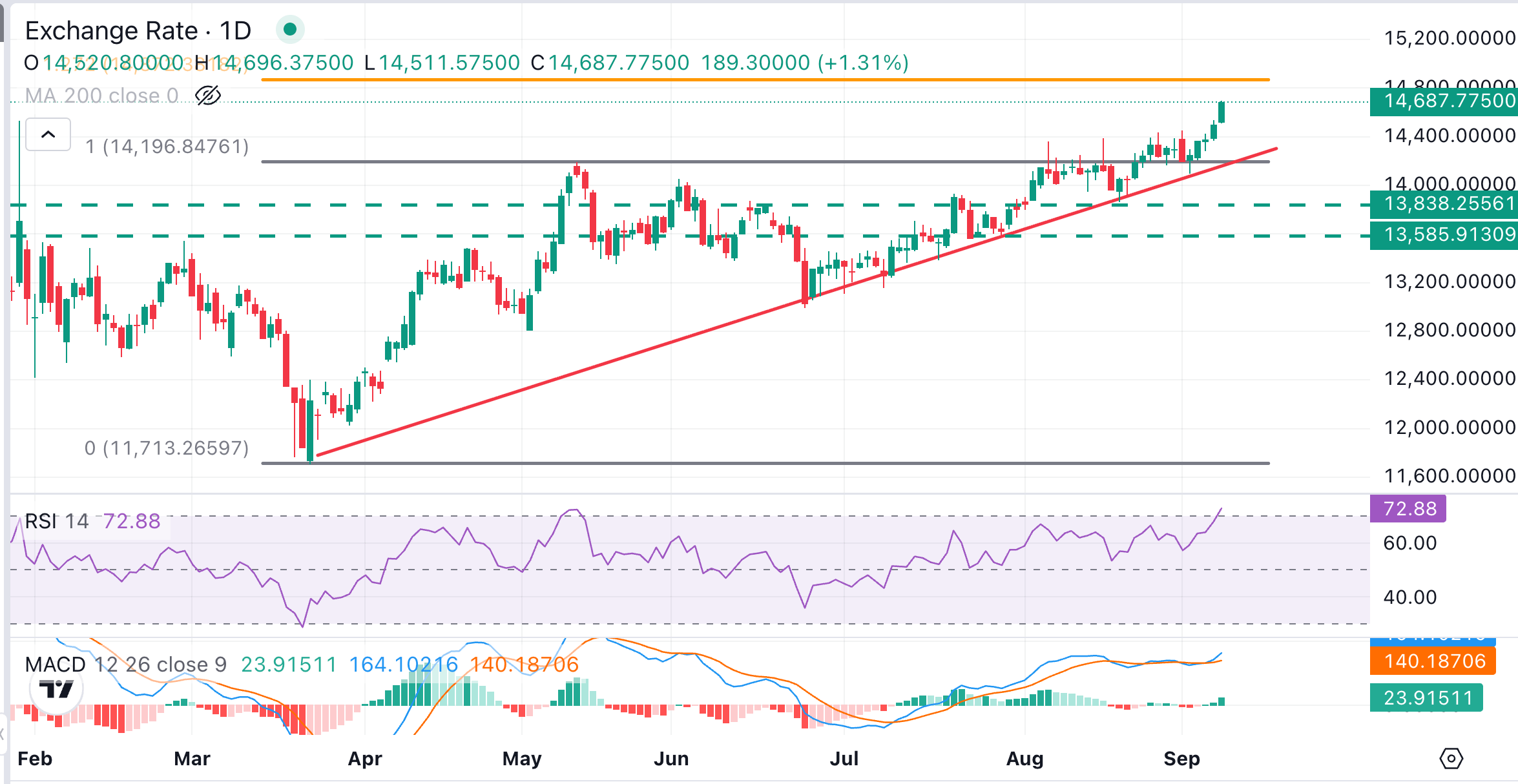
XCU/USD trades at $14,687 at the time of writing, extending a bullish near-term bias with momentum indicators showing overbought levels in most timeframes. The Relative Strength Index (RSI) on the daily chart stands just above 72, and the Moving Average Convergence Divergence (MACD) stays positive and rising, hinting at still-strong but potentially stretched upside momentum.
On the upside, bulls might meet some resistance at the 127.2% Fibonacci extension of the March-May rally, at $14,860, and the psychological $15,000 level. A bearish reaction, on the other hand, is likely to be tested at the ascending trendline from March lows, now around $14,100, ahead of the August 19 low at $13,861, and the July 23 and 29 lows near the $13,600 region.
(The technical analysis of this story was written with the help of an AI tool. Know more.)
Tariffs FAQs
Tariffs are customs duties levied on certain merchandise imports or a category of products. Tariffs are designed to help local producers and manufacturers be more competitive in the market by providing a price advantage over similar goods that can be imported. Tariffs are widely used as tools of protectionism, along with trade barriers and import quotas.
Although tariffs and taxes both generate government revenue to fund public goods and services, they have several distinctions. Tariffs are prepaid at the port of entry, while taxes are paid at the time of purchase. Taxes are imposed on individual taxpayers and businesses, while tariffs are paid by importers.
There are two schools of thought among economists regarding the usage of tariffs. While some argue that tariffs are necessary to protect domestic industries and address trade imbalances, others see them as a harmful tool that could potentially drive prices higher over the long term and lead to a damaging trade war by encouraging tit-for-tat tariffs.
During the run-up to the presidential election in November 2024, Donald Trump made it clear that he intends to use tariffs to support the US economy and American producers. In 2024, Mexico, China and Canada accounted for 42% of total US imports. In this period, Mexico stood out as the top exporter with $466.6 billion, according to the US Census Bureau. Hence, Trump wants to focus on these three nations when imposing tariffs. He also plans to use the revenue generated through tariffs to lower personal income taxes.