
Japanese Yen exposes to two-week low against US Dollar, US PMI eyed
- The Japanese Yen remains under pressure against the US Dollar as the latter outperforms.
- Fed officials have warned of persistent inflation risks amid energy shock and strong demand.
- Investors keenly await Trump-Xi meeting scheduled this week.
The Japanese Yen (JPY) continues to underperform against the US Dollar (USD), with the USD/JPY pair trading 0.3% higher to near 157.85 during the European session on Wednesday. The USD/JPY pair is little far from the two-week high of 158.05 posted on Friday. The pair remains firm as the US Dollar continues to outperform due to warnings of persistent United States (US) inflationary pressures from a slew of Federal Reserve (Fed) officials.
US Dollar Price Today
The table below shows the percentage change of US Dollar (USD) against listed major currencies today. US Dollar was the strongest against the Australian Dollar.
| USD | EUR | GBP | JPY | CAD | AUD | NZD | CHF | |
|---|---|---|---|---|---|---|---|---|
| USD | 0.34% | 0.48% | 0.27% | 0.13% | 0.56% | 0.48% | 0.25% | |
| EUR | -0.34% | 0.13% | -0.04% | -0.19% | 0.22% | 0.12% | -0.09% | |
| GBP | -0.48% | -0.13% | -0.17% | -0.33% | 0.09% | 0.00% | -0.14% | |
| JPY | -0.27% | 0.04% | 0.17% | -0.13% | 0.26% | 0.20% | 0.04% | |
| CAD | -0.13% | 0.19% | 0.33% | 0.13% | 0.41% | 0.34% | 0.17% | |
| AUD | -0.56% | -0.22% | -0.09% | -0.26% | -0.41% | -0.08% | -0.23% | |
| NZD | -0.48% | -0.12% | -0.00% | -0.20% | -0.34% | 0.08% | -0.16% | |
| CHF | -0.25% | 0.09% | 0.14% | -0.04% | -0.17% | 0.23% | 0.16% |
The heat map shows percentage changes of major currencies against each other. The base currency is picked from the left column, while the quote currency is picked from the top row. For example, if you pick the US Dollar from the left column and move along the horizontal line to the Japanese Yen, the percentage change displayed in the box will represent USD (base)/JPY (quote).
An array of Fed members have also stated that not just energy shock but strong demand environment is also fuelling US inflationary pressures.
In European trade, the US Dollar Index (DXY), which gauges the Greenback’s value against six major currencies, posts a fresh seven-week high near 100.89.
Strategists at ING highlight that the Dollar “continues to show very good resilience to lower energy prices and a risk-friendly environment,” arguing this is “another sign that the Fed story is dominant, and the hawkish Fedspeak is enough to keep USD in demand.” They point to comments from Richmond Fed President Thomas Barkin, who “reinforced that message yesterday, arguing that a single rate hike may not be enough to bring inflation under control.” ING notes that Barkin “also noted that resilient labour market conditions should keep consumer spending supported, implying that a dovish shift among the hawks may require clearer signs of labour market softening.”
Meanwhile, investors await the meeting between US President Donald Trump and Chinese leader Xi Jinping, which is due this week.
Later in the day, investors will focus on the preliminary US S&P Global Manufacturing Purchasing Managers’ Index (PMI) data for September. The US Composite PMI is expected to arrive lower due to slowdown in both manufacturing and the service sector activity.
On Tokyo front, financial markets expect Japan’s likely intervention due to severe depreciation in the Japanese Yen in past few weeks.
USD/JPY Technical Analysis
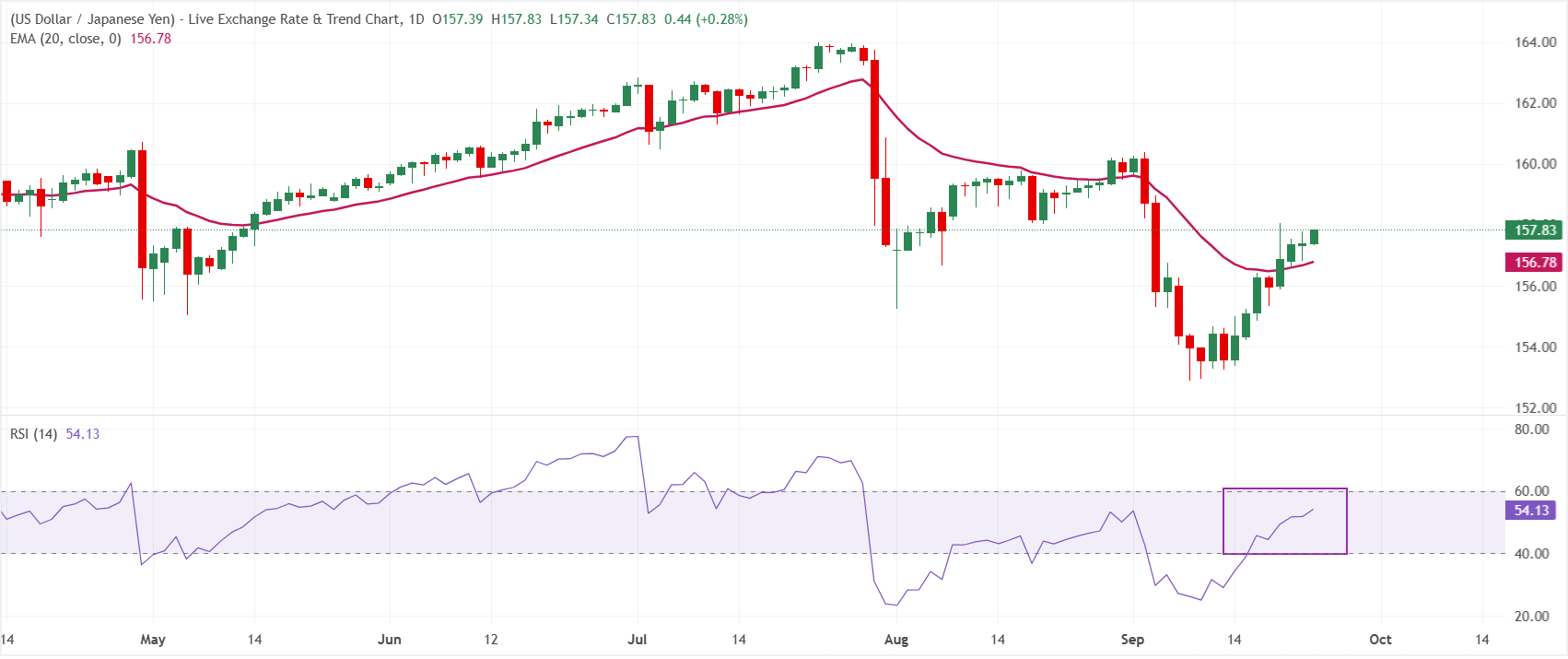
In the daily chart, USD/JPY trades at 157.83, maintaining a mildly bullish near-term bias as spot holds above the 20-day exponential moving average (EMA) at 156.78. The pair is consolidating near recent highs, and the Relative Strength Index (RSI) at 54.14 suggests constructive but not overstretched momentum, hinting that buyers still retain control while upside progress has moderated.
On the downside, initial support emerges at the 157.83 area as a near-term pivot, followed by the 20-day EMA at 156.78 which reinforces the broader positive structure. With no clear overhead technical barriers in the immediate data set, the pair could continue to probe higher levels as long as it sustains above these supports, though momentum readings point more to steady grinding gains than an impulsive breakout.
(The technical analysis of this story was written with the help of an AI tool. Know more.)
Fed FAQs
Monetary policy in the US is shaped by the Federal Reserve (Fed). The Fed has two mandates: to achieve price stability and foster full employment. Its primary tool to achieve these goals is by adjusting interest rates. When prices are rising too quickly and inflation is above the Fed’s 2% target, it raises interest rates, increasing borrowing costs throughout the economy. This results in a stronger US Dollar (USD) as it makes the US a more attractive place for international investors to park their money. When inflation falls below 2% or the Unemployment Rate is too high, the Fed may lower interest rates to encourage borrowing, which weighs on the Greenback.
The Federal Reserve (Fed) holds eight policy meetings a year, where the Federal Open Market Committee (FOMC) assesses economic conditions and makes monetary policy decisions. The FOMC is attended by twelve Fed officials – the seven members of the Board of Governors, the president of the Federal Reserve Bank of New York, and four of the remaining eleven regional Reserve Bank presidents, who serve one-year terms on a rotating basis.
In extreme situations, the Federal Reserve may resort to a policy named Quantitative Easing (QE). QE is the process by which the Fed substantially increases the flow of credit in a stuck financial system. It is a non-standard policy measure used during crises or when inflation is extremely low. It was the Fed’s weapon of choice during the Great Financial Crisis in 2008. It involves the Fed printing more Dollars and using them to buy high grade bonds from financial institutions. QE usually weakens the US Dollar.
Quantitative tightening (QT) is the reverse process of QE, whereby the Federal Reserve stops buying bonds from financial institutions and does not reinvest the principal from the bonds it holds maturing, to purchase new bonds. It is usually positive for the value of the US Dollar.