
New Zealand Dollar retreats from 0.5660 as US Dollar regains ground
- NZD/USD drops from its day’s high of 0.5658, but is still higher at around 0.5630.
- Investors shift their focus to the US NFP data.
- Democrats taking control of both the House and the Senate has clouded the US economic outlook.
The New Zealand Dollar (NZD) gives up half of its early gains against the US Dollar (USD) on Thursday. In the European trade, the NZD/USD pair retreats from day’s high of 0.5658, but is still 0.2% higher to near 0.5630.
The Kiwi pair falls back as the US Dollar regains ground and turns positive, with financial markets shifting their focus to the United States (US) Nonfarm Payrolls (NFP) data for October, which is scheduled for Friday.
As of writing, the US Dollar Index (DXY), which gauges the Greenback’s value against six major currencies, trades 0.1% higher to near 101.60. The USD Index bounced back strongly after revisiting the monthly low of 101.01 posted the previous day.
Investors will pay close attention to the US NFP data to get fresh cues regarding the Federal Reserve’s (Fed) monetary policy outlook.
Fed hike risks stay live as TD looks for subdued October jobs print
According to TD Securities, October’s US employment report is likely to show only modest job creation, with economists looking for nonfarm payrolls to “remain subdued at 40k after job gains moderated to 29k in September.” They note that, “despite the subdued, below-consensus print, our forecast would be within the range of breakeven job gains and result in an increase in the three-month moving average,” suggesting underlying momentum is not as weak as the headline figure implies. TD also flags that “risks to our payrolls forecast are to the upside,” cautioning that “seasonal factors could reverse again more than expected and lead to a stronger print.” Against a backdrop of “underlying activity in the economy robust and inflation risks still prominent,” the bank concludes that “a hike in December is likely.”
The US Dollar had been underperforming as the victory of Democrats in US midterm elections has clouded the economic outlook.
Dollar outlook darkens on US political frictions into 2027
Analysts at ING suggest that the US political backdrop could become an additional headwind for the Dollar over the medium term. They argue that “the dollar could see a little more weakness into 2027, however, if an emboldened Democratic Party takes greater issue with Republican policy, including deregulation and the AI build-out.” ING adds that “the potential for a prolonged government shutdown in mid-2027 adds to the case for a weaker dollar next summer,” reinforcing their view that rising political frictions may increasingly weigh on the currency’s appeal.
NZD/USD Technical Analysis
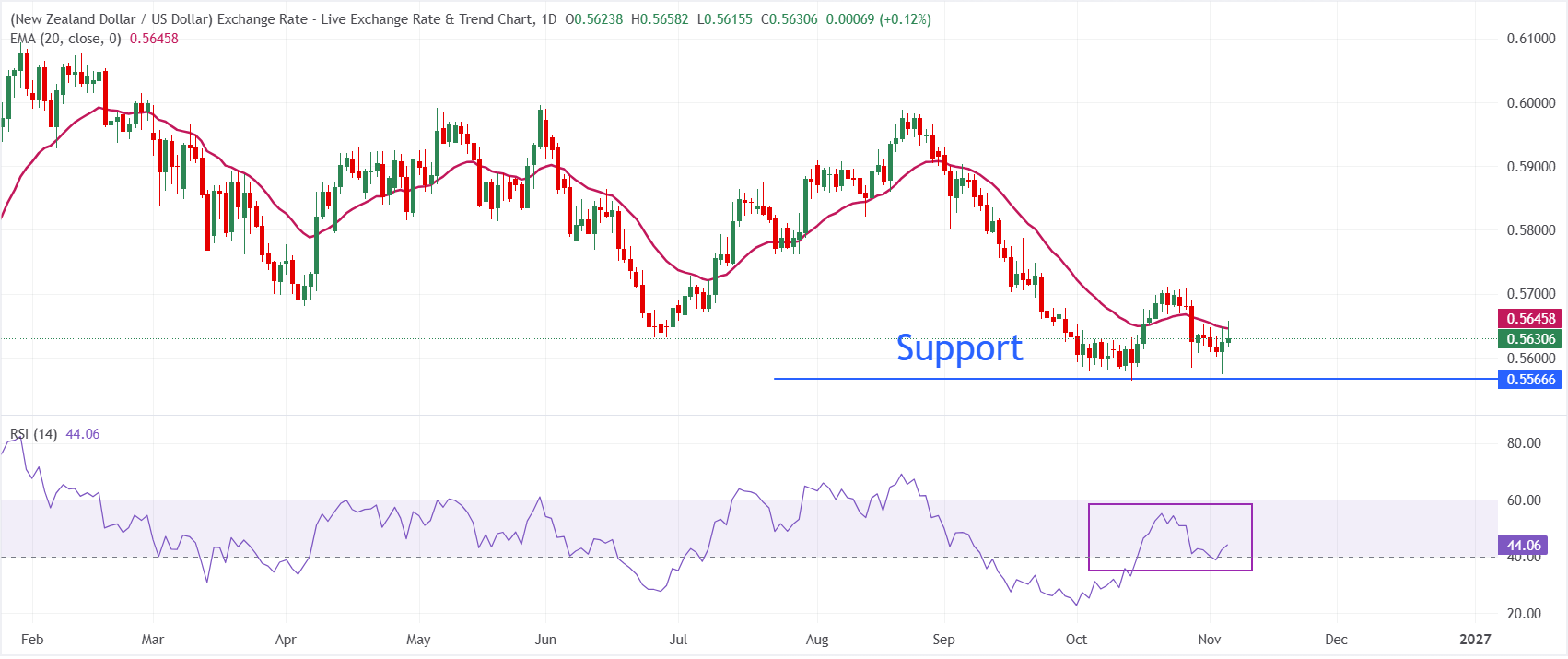
In the daily chart, NZD/USD trades at 0.5631, keeping a bearish near-term bias as spot holds beneath the 20-day exponential moving average (EMA) at 0.5646. The pair remains capped by this nearby dynamic barrier, suggesting rallies are likely to struggle while price stays under it, even as the Relative Strength Index (RSI) recovers toward the mid-40s, hinting at easing but still modest downside pressure.
On the topside, initial resistance is located at the 20-day EMA at 0.5646; a daily close above this level would be needed to ease the current bearish tone and open room for a corrective advance. With no clear nearby support levels derived from the provided indicators below the market, traders may look to recent lows on the price chart itself for potential demand zones, while respecting the prevailing downside bias as long as NZD/USD trades under its short-term EMA.
(The technical analysis of this story was written with the help of an AI tool. Know more.)
Nonfarm Payrolls FAQs
Nonfarm Payrolls (NFP) are part of the US Bureau of Labor Statistics monthly jobs report. The Nonfarm Payrolls component specifically measures the change in the number of people employed in the US during the previous month, excluding the farming industry.
The Nonfarm Payrolls figure can influence the decisions of the Federal Reserve by providing a measure of how successfully the Fed is meeting its mandate of fostering full employment and 2% inflation. A relatively high NFP figure means more people are in employment, earning more money and therefore probably spending more. A relatively low Nonfarm Payrolls’ result, on the either hand, could mean people are struggling to find work. The Fed will typically raise interest rates to combat high inflation triggered by low unemployment, and lower them to stimulate a stagnant labor market.
Nonfarm Payrolls generally have a positive correlation with the US Dollar. This means when payrolls’ figures come out higher-than-expected the USD tends to rally and vice versa when they are lower. NFPs influence the US Dollar by virtue of their impact on inflation, monetary policy expectations and interest rates. A higher NFP usually means the Federal Reserve will be more tight in its monetary policy, supporting the USD.
Nonfarm Payrolls are generally negatively-correlated with the price of Gold. This means a higher-than-expected payrolls’ figure will have a depressing effect on the Gold price and vice versa. Higher NFP generally has a positive effect on the value of the USD, and like most major commodities Gold is priced in US Dollars. If the USD gains in value, therefore, it requires less Dollars to buy an ounce of Gold. Also, higher interest rates (typically helped higher NFPs) also lessen the attractiveness of Gold as an investment compared to staying in cash, where the money will at least earn interest.
Nonfarm Payrolls is only one component within a bigger jobs report and it can be overshadowed by the other components. At times, when NFP come out higher-than-forecast, but the Average Weekly Earnings is lower than expected, the market has ignored the potentially inflationary effect of the headline result and interpreted the fall in earnings as deflationary. The Participation Rate and the Average Weekly Hours components can also influence the market reaction, but only in seldom events like the “Great Resignation” or the Global Financial Crisis.